The operating room is quietly becoming a data center with scalpels. In 2025, Intuitive Surgical's robots performed 3.1 million procedures (+19% YoY). But the procedure-count number misses the real story: haptic force feedback that reduces tissue trauma by 43%, CRISPR gene edits moving into 5-year-olds, and $5 acute-pain pills replacing opioids at scale.
Medical Devices 2.0 is not about smaller incisions or faster recovery. It is about rewriting the human body's source code — at the molecular, cellular, and surgical layers — inside a single hospital visit. Five names in the AICcelerate engine universe sit across the four layers of the stack.
Why Now
Five simultaneous inflections hit in Q4 2025 and Q1 2026:
- Intuitive's da Vinci 5 crossed 12,100 installed systems with Case Insights AI now analyzing every procedure. FDA cardiac clearance unlocked approximately 160,000 additional annual procedures on top of the existing base.
- Vertex's CASGEVY expanded into pediatric sickle cell disease (ages 5-11) with an FDA Priority Review Voucher. 64 patients were infused in 2025, with 30 of those in Q4 alone — the ramp is real.
- Illumina closed the $425M SomaLogic acquisition on January 30, 2026, pivoting from sequencing-only to multiomics (genomics + proteomics).
- Regeneron queued 4 FDA approvals and 18 Phase III starts for 2026, including the first muscle-preserving obesity adjunct (Olatorepatide) entering global registrational trials late 2026.
- Vertex's JOURNAVX crossed 550,000 non-opioid pain prescriptions in 10 months. Prescribers are shifting from opioids to suzetrigine faster than payer models predicted.
The category is re-rating from "devices" to "programmable biology." The surgeon, the sequencer, and the gene editor are becoming one integrated diagnostic-therapeutic stack.
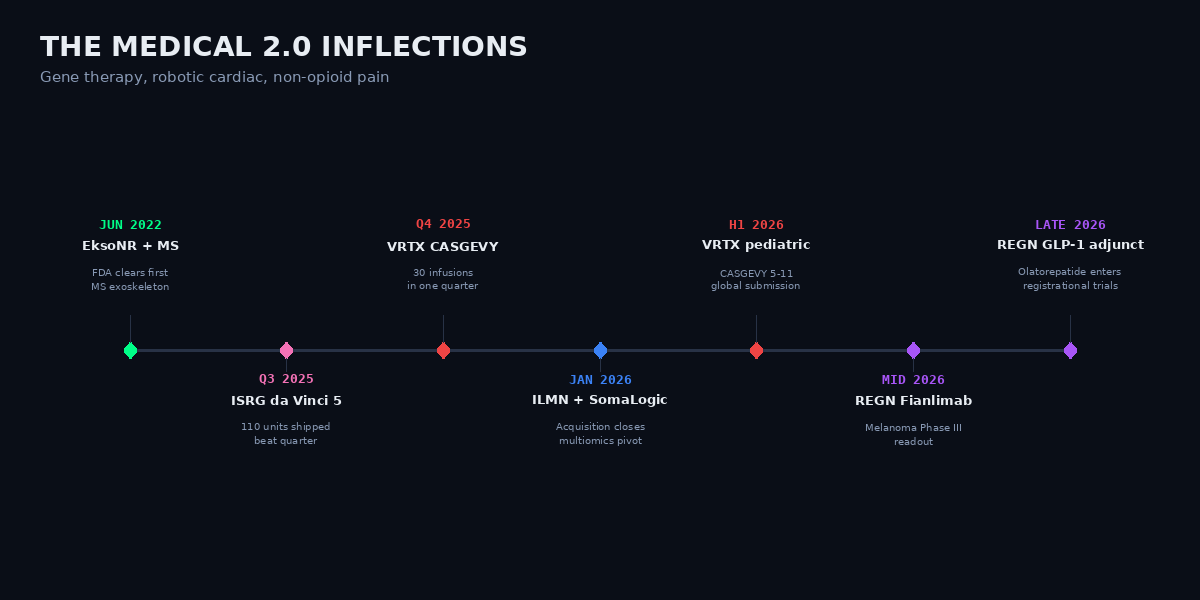
Figure 1 — The Medical 2.0 Inflections
Five Names, Four Layers
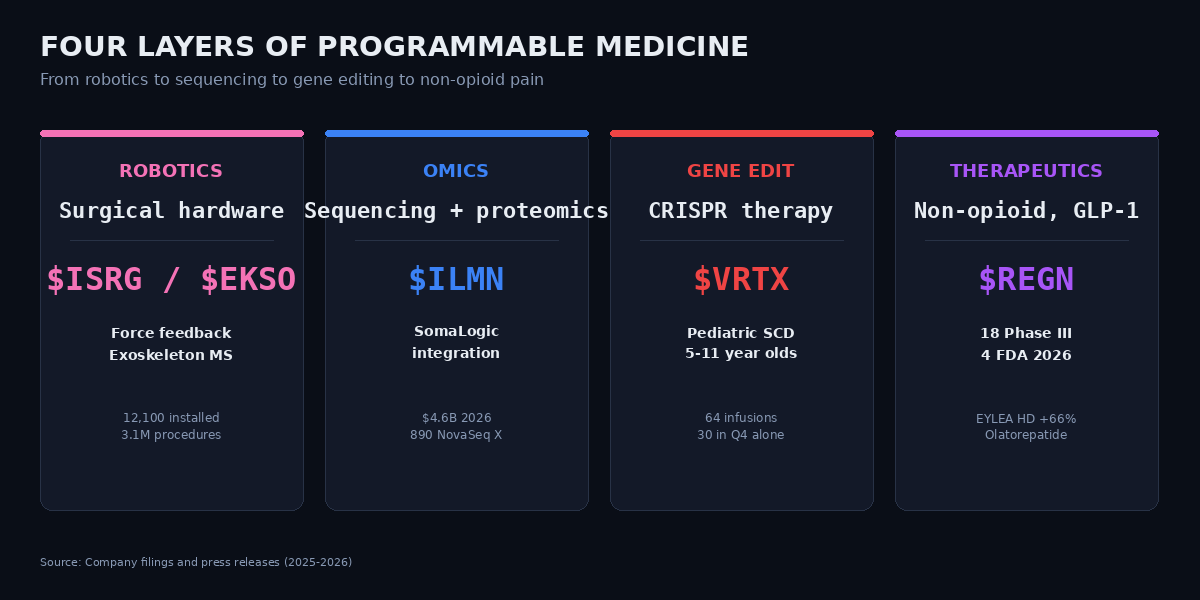
Figure 2 — Four Layers of Programmable Medicine
$ISRG — Intuitive Surgical (NASDAQ) · Surgical Robotics
da Vinci 5 cardiac clearance (FDA, Q1 2026) unlocked approximately 160,000 additional annual procedures. 2026 procedure growth guided 13-15% on an installed base of 12,100+. Force feedback plus AI Case Insights widens the moat with every procedure — da Vinci 5 force feedback reduces tissue force by up to 43%, unlocking cardiac, colorectal, and complex hepatobiliary categories that were previously considered too delicate for robotics. The TAM step-up is not linear.
$EKSO — Ekso Bionics (NASDAQ) · Rehab Robotics
Exoskeleton rehab pure-play. Q4 2025 revenue $5.1M (+5%); analysts model 2026 revenue +55% to $23.2M. EksoNR is the only FDA-cleared exoskeleton for MS and traumatic brain injury. Small-cap, high-beta, binary on adoption curve — Ekso's fate depends on whether reimbursement expands from acute stroke to MS and brain-injury cohorts in 2026-2027. The clinical evidence is strong; the payer decisions are the gate.
$ILMN — Illumina (NASDAQ) · Sequencing + Proteomics
Completed the SomaLogic acquisition January 30, 2026 — Illumina is no longer just a sequencing company. 2026 guide $4.5-4.6B revenue, 890 NovaSeq X systems installed, Q70 quality roadmap + 40% output lift. Clinical consumables growing mid-teens. The multiomics pivot matters because diagnostic questions increasingly require both genome and proteome data — and Illumina is the only vendor with both under one roof at scale.
$REGN — Regeneron (NASDAQ) · Therapeutics + Obesity Adjuncts
Four FDA approvals targeted in 2026. EYLEA HD grew +66% YoY in Q4 2025, LIBTAYO +13%. Olatorepatide — a muscle-preserving GLP-1 adjunct — entering global registrational trials late 2026. The Fianlimab/Libtayo melanoma Phase III readout mid-2026 is the wildcard: positive data re-rates the entire immuno-oncology pipeline. Regeneron is one of the few large-cap biotechs with a clinical-readout-driven 2026 catalyst path that has not already re-rated.
$VRTX — Vertex Pharmaceuticals (NASDAQ) · Gene Editing + Non-Opioid Pain
CASGEVY pediatric submissions in H1 2026 under FDA Priority Review Voucher. 64 patients infused in 2025, 30 in Q4 alone — the ramp is real. JOURNAVX (suzetrigine) reached 550,000+ prescriptions in year one of launch. Non-CF revenue guided $500M+ for 2026. Vertex is unique: simultaneous gene-therapy commercial ramp plus first-in-class non-opioid pain franchise, either of which alone would justify a significant re-rating.
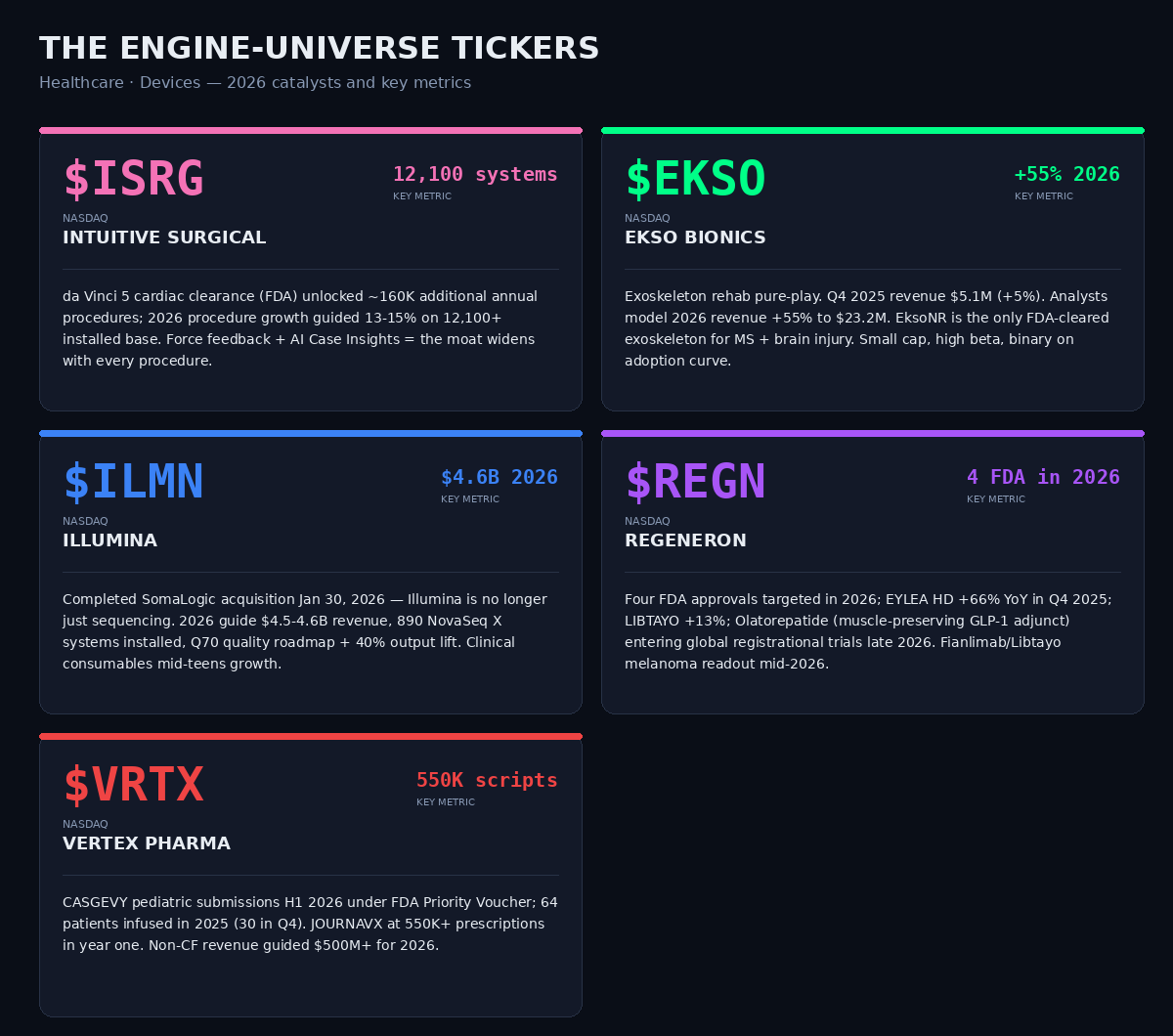
Figure 3 — Engine Universe Exposure
The Non-Obvious Insight
The surgical robotics TAM everyone quotes ($9B-$16B) understates the real opportunity by an order of magnitude. Only approximately 15% of eligible surgeries are currently robotic. Intuitive's da Vinci 5 force feedback reduces tissue force by up to 43%, which is the unlock for cardiac, colorectal, and complex hepatobiliary procedures that were previously considered "too delicate" for robotics. Meanwhile at the molecular level, $ILMN just merged sequencing with proteomics (SomaLogic) while $VRTX is running gene edits in 5-year-olds. The convergence thesis: the surgeon, the sequencer, and the gene editor are becoming one integrated diagnostic-therapeutic stack within a single hospital visit. The stock beneficiaries are the platforms that own the data layer that moves between those three roles — and $ISRG Case Insights is the only platform currently doing that.
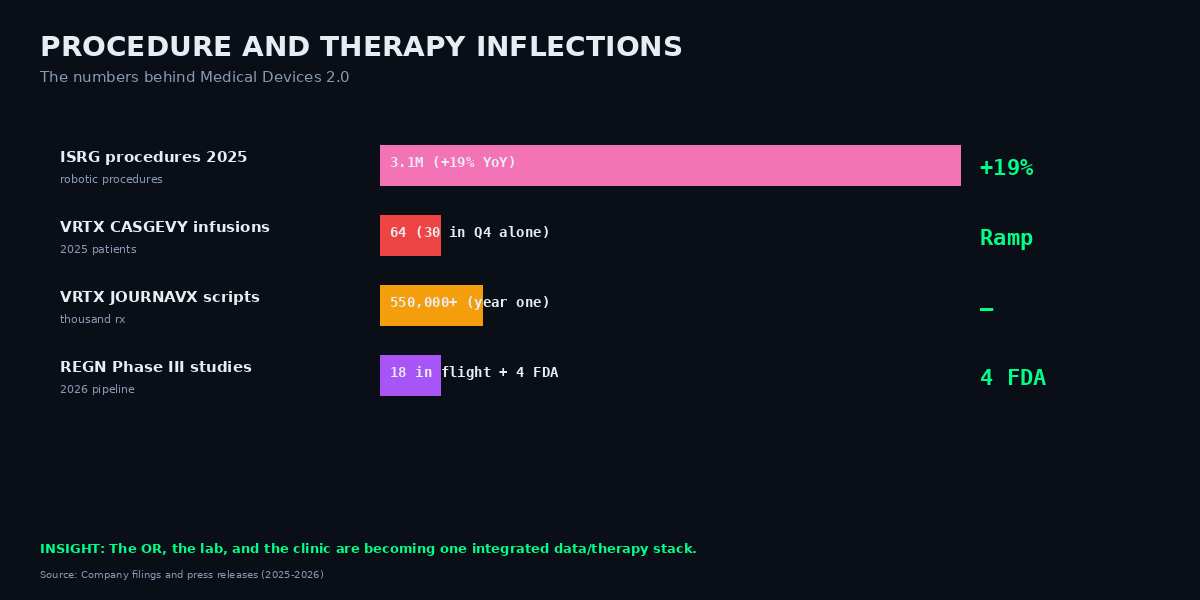
Figure 4 — Procedure and Therapy Inflections
Risks & Disconfirming Evidence
- $ISRG valuation premium. Trading at approximately 50× forward earnings, $ISRG prices in flawless da Vinci 5 execution. Medtronic's Hugo and J&J's Ottava are gaining ground internationally. A single soft procedure-growth quarter re-rates $ISRG materially.
- $EKSO cash burn and concentration. Cash burn exceeds 100% of revenue. Going-concern pressure materializes quickly if 2026 revenue disappoints. Smallest cap in the group.
- $VRTX CASGEVY commercial ramp. Has been slower than buy-side hoped. The ~$2.2M list price creates payer friction. Gene-therapy reimbursement is still being negotiated market-by-market. The 30-patients-in-Q4 number is encouraging but not conclusive.
- $ILMN China exposure remains a drag. Ultima Genomics and Element Biosciences target the sequencing monopoly with lower-cost chemistry. Regulatory: FDA change in review timelines under the new administration could compress or stretch approval windows across the entire basket.
Engine Signal Context
The AICcelerate engine universe contains all five named tickers — $ISRG, $EKSO, $ILMN, $REGN, $VRTX — alongside 174 other US equities. The engine runs signal detection on each independently of the macro narrative.